
European Business Summit 2018: Summary
The European Business Summit was an opportunity for us at YouthProAktiv to attend a number of sessions most relevant to proactive, entrepreneurial young people, covering topics such as the future of work, skills for success, entrepreneurship, digitalisation, financial conditions for startups, education and training, the European and national perspectives, technical developments and others. We listened, asked, suggested, learned, met wonderful new people and discussed all that matters to the young people and others we represent. Below, you can find a brief overview of some of the sessions we attended. Enjoy!
Empowering Young Entrepreneurs: Building Institutional Support 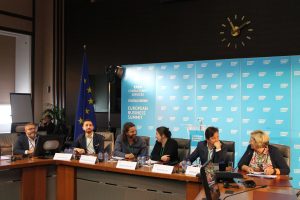
This inspiring roundtable presented views of five diverse professionals: Andrea Gerosa – ThinkYoung Founder and “Chief Thinker”; Kim Baden-Kristensen – Brain+ Co-founder and CEO; Denis Terrien – Novartex Chairman of the Board, experienced founder and business leader; Andrea Kindler – Enterprise Europe Network Austria Project Manager; and moderator Rebecca Christie – freelance journalist/writer.
Mr Gerosa talked about two problems he sees in Europe: negotiation and selling skills for entrepreneurs, on which there is not enough emphasis here, as well as our attitudes towards failure and risk-taking. These were agreed and elaborated by others too. Mr Baden-Kristensen and Mr Terrien highlighted also the need to have access to information, advice and resources. Ms Kindler, whose large EC-funded network helps young startups, loves working with young entrepreneurs who are passionate and put everything in their ideas and helping them navigate through the jungle and avoid mistakes. Capital and its availability was not generally seen as the biggest problem for young entrepreneurs, though it was acknowledged it is not always easy to get it. According to Mr Baden-Kristensen, the reason could also be that maybe the idea is not good enough, maybe you have not worked on the idea hard enough, or then you are not good enough at selling the idea. The speakers addressed the question of gender in business too, and many wanted to see more role models for young women, along with supportive regulations. Last but not least, thoughts were given on how to engage young people early on and develop their entrepreneurial skills and spirit.
Have a look at a more detailed report: Empowering Young Entrepreneurs: Buildings Institutional Support
Creativity at the heart of businesses, a key to success? 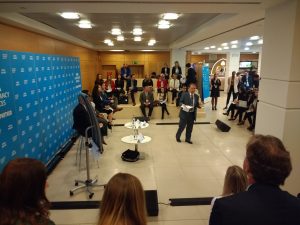
What is the relationship between creativity, innovation and disruption? How do these work specifically for entrepreneurs and innovators? And what do people actually mean by ‘creativity’ and ‘innovation’ – and why do we need these?
These were some of the questions explored during an agora debate with five people representing different ‘creative’ and ‘non-creative’ backgrounds: Bartholomeus-Henri Van de Velde, Orchestra Conductor, Music Producer, and Change Management Expert with ifa laboratory as the moderator; Javier Echarri, CEO at European Business & Innovation Centres Network; Zeldah Schrama, Entrepreneurship Coach, Change Manager and Connect Africa Founder and Consultant; Frederique Paccagnella, HR expert and Director at Excel Careers; and Thomas Van Halewyck, Co-Founder and CEO at Bundl; with contributions and further questions from the audience too.
Panellists agreed on a number of points, such as innovation requiring more than just a great idea. “It is not about the brilliant idea, but about making it stay,” said Mr Echarri, echoing an earlier remark from Mr Van de Velde: “How innovative and creative are you in your business? It’s not about creating a new product. New is always easy. What is difficult? To continue.” Mr Van Halewyck expanded on how he sees the relationship between creativity and innovation: creativity is essential, but it only leads to innovation if it meets the market needs.
Apart from trying to define creativity and innovation, the experts also discussed their professional perspectives and experience, innovative practices, risk-taking and development of creativity, and highlighted the importance or proactivity, dedication and passion.
Read our more detailed event report: Creativity at the Heart of Businesses, a Key to Success?
How to Digitise EU’s Industry
Digitalisation was one of recurring topics at the summit, and this roundtable brought together a group of speakers to look at particular aspects of this growing trend: Katarzyna Jakimowicz, Associate Director at the Lisbon Council for Economic Competitiveness and Social Renewal; Antti Peltomäki, Deputy Director General, DG GROW; Sandeep Simon, Utilities Segment Head, Europe, TATA Consultancy Services; Eva Maydell, MEP; Bruni Basalisco, Head of Digital Economy service at Copenhagen Economics; and moderator Julia Fioretti, Correspondent for Reuters News Agency.
The various societal and technological changes, gaps and related statistics often served as a springboard for discussions about skills, education and helping young people be prepared for successful future and the labour market. Education needs to focus more on development of skills, both digital skills and transversal, soft and entrepreneurial skills, including “learning how to learn, being more adaptable, bringing out your creativity,” as Ms Maydell stressed.
Why not read a more detailed analysis on our website? How to Digitise EU’s Industry
Closing the E-Skills Gap 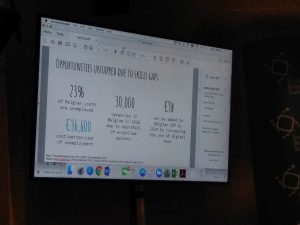
Karen Boers, CEO of BeCode.org and Co-founder & Managing Director of Startups.be, was an expert invited to look at e-skills, the importance of these in the current labour market and some of the recent initiatives.
Continuous changes of the labour market and the current unemployment situation, not only among young people, are related to a skills gap between what employers need and what is offered by job seekers. Despite technology being a problem for most people, “all people can learn it”, she believes. Education has to change, however because, the new technologies are different, as well as the labour market.
Check more on the session: Closing the E-Skills Gap
Basic Income, Will it Ever Happen? 
The concept of a “universal basic income” has been gaining more and more momentum and also led to trials being proposed and implemented, with varying success. The dedicated EBS debate featured Guy Standing, Professional Research Associate at SOAS, University of London, and a founding member and Honorary Co-President of the Basic Income Earth Network (BIEN), with Chris Burns, Freelance Journalist, moderating.
As Mr Standing told the audience, “basic income gives us freedom because poverty gives insecurity”. He believes that if people had more security, they would progress, they would think about starting their own business or changing their job looking for better labour conditions; financially safe people are capable of improving their living conditions, thrive in their cities and, consequently, improve these cities, creating business and progress together.
What do you think about the concept? Does basic income have more advantages than disadvantages? Would it help proactive young people create their own startups to benefit the society and follow their dreams?
You can find more details in our article: Basic Income, Will It Ever Happen?
Retail Competitiveness in the Age of Digitalisation 
Competitiveness, digitalisation and the changing labour market were among the topics addressed at the roundtable. The concept of a ‘job for life’ seems to be disappearing, for example. The key is for us to adapt and prepare for the future. New skills, especially digital skills, and transformation of companies for the new digitalisation are at the heart of the challenge. “The job you did at 25 may not be the job you do at 55 or 60,” remarked Christian Verschueren, Director at EuroCommerce.
The roundtable also featured: Irmfried Schwimann, Deputy Director-General for at DG GROW at the European Commission; Jasmi Battista from DG CONNECT; Anneleen Van Bossuyt, MEP; Thorsten Marquardt, Managing Director of Retailtech Hub; and Bruno Basalisco, Head of Digital Economy Service of Copenhagen Economics; and was moderated by Eszter Zalan, EUobserver Reporter.
You can read more in the dedicated article: Retail Competitiveness in the Age of Digitalisation
Crypto Revolution 
How will the ‘crypto revolution’ affect work and life? It comes not only with technological advancements but also a social revolution and is expected by many to bring more efficiency, transparency and flexibility to the economic landscape. YouthProAktiv had the opportunity to learn more about what some refer to as “the genesis of the 4th industrial revolution” at a ‘meet-the-expert’ session with two experts: Jean-Loick Michaux, Founder of Serendipia Cooperative, Social Entrepreneur and Investor, and Elizabeth Hunker, Entrepreneur in Residence, Investor and Advisor. The session aimed to show the audience how the crypto revolution will forever transform how we live but also how token economics will help to eradicate poverty in developing countries within the next 20 years. A lot of people in the world, especially in Africa, cannot open a bank account, and blockchain technology can help people from around the world have access to new resources and thus improve their lives.
Closing Plenary 1: Leading in a Changing World 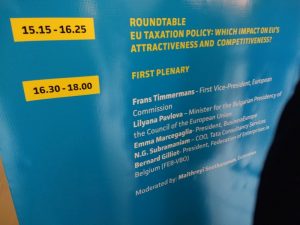
Day 1 was wrapped up in a high-level plenary reflecting on the challenges, possibilities and positives currently surrounding Europe. The host, Maithreyi Seetharaman, Euronews Real Economy Anchor and Co-Chair at Fortune Most Powerful Women Internationl, started by thanking delegations from as far as India, China and Japan for coming to the summit, allowing for not only the European but also the global perspective to be truly represented. She also ceremoniously presented the first speaker, Frans Timmermans, First Vice-President for Better Regulation, Inter-institutional Relations, the Rule of Law and the Charter of Fundamental Rights at the European Commission, with a collection of essays written by global leaders specifically for the summit. (You can download an electronic copy from the summit’s official website.) Other speakers included: N. Ganapathy Subramaniam, Chief Operating Officer & Executive Director of Tata Consultancy Services; Markus J. Beyrer, Director General of BusinessEurope; Bernard Gilliot, President of the Federation of Enterprises in Belgium; and Lilyana Pavlova, Minister for the Bulgarian Presidency of the Council of the EU.
Challenges, such as the many uncertainties in the world, related for example to trade policies and deals, migration, cyber security and digitalisation, decrease in business confidence and competition with non-European countries were acknowledged. However, the amazing potential of Europe and its unity was a strength of ours that needs to be nourished and protected.
YouthProAktiv left the plenary discussion with a lot of new insights, and faith in Europe that supports innovation, creativity, proactivity and entrepreneurship.
 Artificial Intelligence: How Will It Change the Future of Work?
The moderator Victoria Main, Vice-President and Director for Tech&Media at Cambre Associates, called this a “superpanel – not just because of the size, but also because of the topic”. Introductory remarks of the ten diverse panellists ended on a very positive note, with the exciting possibilities highlighted by many. Emphasis was put on the need of collaboration, also with policy-makers, and on education in order to properly understand the consequences of technological progress. Interesting points were made on what else implementing AI means: it is also about being mindful, caution, creativity and positivism, among others. As mentioned at some other sessions related to digitalisation and technological advances, the panellists believed that AI will not simply replace human workers at some point, and we need to learn how to use it to our advantage, regulate it and educate people.
EU Taxation Policy: Which Impact on EU’s Attractiveness and Competitiveness?
This roundtable featured a number of high-profile speakers who analysed the impact of the EU taxation policy on competitiveness but also looked at the fight against tax fraud and tax avoidance, fairness in taxation, and the impacts of digitalisation. The speakers included: Pierre Moscovici, European Commissioner for Economic and Financial Affairs, Taxation and Customs; The Hon. Tara Rivers, Minister of Financial Services of Cayman Islands Government; Jeffrey Franks, Director of the International Monetary Fund Europe; Alain Lamassoure, MEP; Pascal Saint-Amans, Director of OECD Centre for Tax Policy and Administration; Prof. Dr. Hans van den Hurk, Professor in Tax Law at Maastricht University; Serge Krancenblum, CEO of the SGG Group; and Krister Andersson, Chairman of the Tax Policy Group of BusinessEurope; with Sasha Vakulina, Business Editor with Euronews, as moderator.
In terms of environment supportive of entrepreneurial activities, Mr Moscovici believes that business needs simplicity and certainty and more fairness, irrespective of the size of the company. Mr Franks wants to see a tax system that is an incentive toward investment, innovation and research. Mr Andresson remarked that the world is moving rapidly, and Europe needs to react and become more competitive. Mr Krancenblum agreed and added that, all of us Europeans, “we are part of the solution”.
European Year of Cultural Heritage: Investing in Cultural Heritage Pays Off
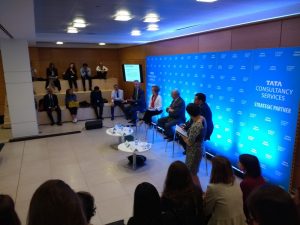
This was “the first ever cultural heritage summit within a business summit,” started excitedly the moderator Sneska Quaedvlieg-Mihailovic, Secretary General of Europa Nostra, who found this even more important because 2018 is the European Year of Cultural Heritage. She welcomed the panel of speakers: Viviane Hoffmann, Deputy Director General for Education, Youth, Sport and Culture at the EC; Comte Rodolphe de Looz-Corswarem, President of the European Historic Houses Association; Gerry Salole, CEO of the European Foundation Centre; and Karel Lannoo, CEO of the Centre for European Policy Studies. She stressed that heritage is a very important driver of sustainable development, and that when it comes to hard figures and evidence, they can prove the underused potential of cultural heritage even in the economic sense, sharing with the audience revealing statistics.
Comte de Looz-Corswarem, who was previously a businessman in the food and drink industry, reflected with astonishment that twenty-five years ago, he organised a big business event himself, and it never crossed his mind to invite anyone from the cultural sector – he felt extremely happy about the progress being made, and his passionate speech led the moderator to remark on the similarities between businessmen, policy-makers and people from the cultural sector: “In order to be successful at lobbying, you have to be professional, competent and passionate.” On top of other initiatives, some recent publications were presented, such as the final report on the project Cultural Heritage Counts for Europe.
New Pact for Europe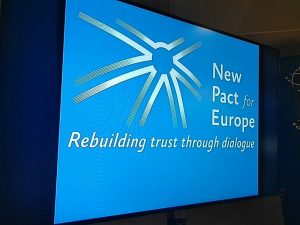
Janis Emmanouilidis, Director of Studies of the European Policy Centre, was an expert invited to present the latest New Pact For Europe report. The New Pact for Europe initiative aims to rebuild trust through national and transnational dialogue and develop a new common ground on the way forward for the European Union. The report reflects more than 120 debates on the state and the future of the European Union, which have taken place in a majority of EU countries since 2013 under the auspices of the project. As the organisers believe, Europe is facing multiple crises around the world threatening the European project, with new crises emerging and old ones not fully overcome yet, and some nations are feeling disillusioned about the EU, its perceived inefficiency, unequal and unfair treatments of certain countries, inability to consider national interests or to deal with the refugee and migration crisis. The report proposes important building blocks and concrete stepping stones ahead and asks EU member states for the will and courage to agree on a win-win package to counter the dangers of a broken Europe. However, everyone can contribute to re-energising Europe – and proactive young people are a powerful force for positive change.
YouthProAktiv at the EBS2018
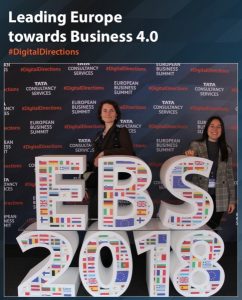 For two full days, we listened, asked, suggested, learned, met wonderful new people and discussed all that matters to the young people and others we represent. We had the chance to get a glimpse into the work of dozens of organisations and individuals contributing to the creation of a proactive, entrepreneurial culture; to shake hands with inspiring entrepreneurs, experts and young leaders; to note down dozens of reports, initiatives and opportunities that we cannot wait to study in more detail; and to represent our network and the ideas it stands for as well as the civil society.
We also actively engaged on social media, making sure that attendees and policy-makers are reminded of the perspective of proactive youth and the important work YouthProAktiv has been doing on promoting and contributing to a proactive, entrepreneurial culture across Europe and beyond, and we reported extensively on the important developments and actors in the relevant areas.